
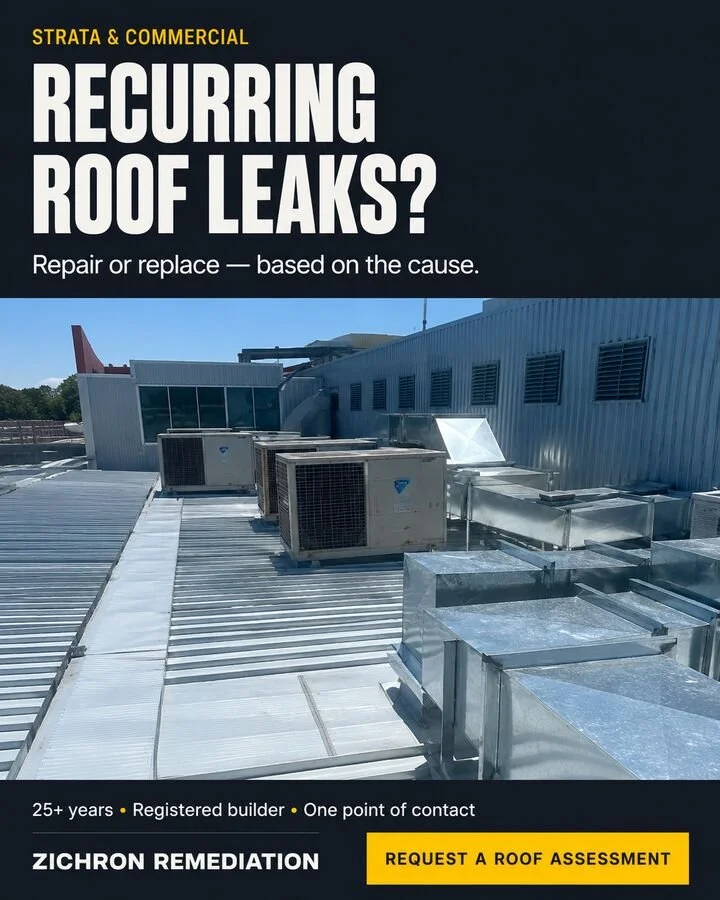
Recurring Roof Leaks in Managed Properties: Repair, Restore or Replace?
A practical guide for strata and property managers on diagnosing recurring roof leaks and deciding whether targeted repair, restoration or replacement is the right response.
A practical decision guide for strata, Owners Corporation and commercial property managers in Melbourne.
IN BRIEF
A recurring roof leak should be treated as an investigation problem before it becomes a product-selection problem. A targeted repair suits a defined defect in an otherwise serviceable roof. Restoration addresses broader but recoverable deterioration. Replacement becomes the stronger option when failures are widespread, interfaces are deteriorated or repeated repairs no longer provide dependable value.
WHY THE VISIBLE LEAK IS NOT ALWAYS THE SOURCE
Water follows gravity, but it can also travel along laps, framing, insulation, fixings and service penetrations. A ceiling stain may appear several metres from the point where rain first entered. Wind-driven rain may move upward at poorly formed laps or enter around flashings before tracking across concealed building elements.
This explains why repeatedly sealing the area directly above a stain can fail. The sealant may be sound while the true entry point remains untreated. An overflowing gutter may also drive water behind a flashing only during a particular wind direction or rainfall intensity.
COMMON FAILURE ZONES
Flashings and junctions. Changes in level, abutments, parapets, cappings and roof-to-wall interfaces concentrate movement and are common places for detailing failures to appear.
Penetrations and rooftop plant. Vent pipes, skylights, ducts, fixings and equipment introduce interfaces that require compatible flashings, seals and drainage paths.
Gutters, outlets and falls. Blockages, insufficient capacity, poor falls or restricted outlets can cause ponding and overflow, particularly during intense rain.
Sheets, tiles and membranes. Corrosion, displaced tiles, failed laps, punctures, brittle membranes and aged fasteners may create isolated or system-wide vulnerability.
TECHNICAL PATHWAY: FROM SYMPTOM TO DEFENSIBLE SCOPE
1. Record the evidence. Note rain direction, duration, affected rooms, frequency, previous repairs and photographs.
2. Trace the water path. Inspect the roof covering, flashings, penetrations, gutters, outlets and concealed travel where safely accessible.
3. Assess the extent. Decide whether the evidence indicates an isolated defect, recoverable deterioration or widespread/end-of-life system failure.
4. Scope the response. Define a targeted repair, coordinated restoration or planned replacement, together with documentation and property coordination.
A DISCIPLINED ROOF-LEAK INVESTIGATION
1. Build an incident history
Good information narrows the inspection. Managers should record the date and approximate time of each leak, rainfall severity, wind direction if known, rooms affected, whether rooftop plant was operating and what temporary measures were used. Historical photographs, invoices and prior scopes may reveal a repeated failure zone or a pattern of short-term patching.
2. Inspect the roof as a system
The investigation should not stop at the most obvious damaged component. It should consider roof sheets or tiles, membranes, laps, fasteners, flashings, cappings, penetrations, gutters, sumps, downpipes, outlets, overflows, roof falls and interfaces with walls or plant platforms. Safe access and weather conditions will determine what can be inspected on the day.
3. Correlate external and internal evidence
Ceiling stains, damp insulation, corrosion, mould, damaged linings and moisture readings may help indicate direction and duration. Where the water path is concealed, further controlled investigation may be needed. Any destructive inspection should be planned and agreed rather than improvised.
4. Define cause, consequence and extent
A useful report distinguishes the likely entry mechanism from the resulting damage. It also identifies whether the defect is local or representative of wider deterioration. This distinction drives the repair-versus-replacement decision and helps owners understand why two superficially similar leaks may require very different scopes.
REPAIR, RESTORATION OR REPLACEMENT?
TARGETED REPAIR
Usually suitable where the defect is isolated, accessible and clearly identified, and the surrounding materials remain serviceable. The repair must integrate with the existing system without obstructing drainage or moving water elsewhere.
ROOF RESTORATION
Usually suitable where several components require coordinated renewal but the primary roof system remains appropriate to retain. A coating alone will not correct poor falls, inadequate outlets, incompatible detailing or an unsound substrate.
ROOF REPLACEMENT
Usually suitable where deterioration is widespread, failures recur across multiple zones, or service life and lifecycle cost support renewal. Replacement planning must address drainage, penetrations, rooftop plant, access, temporary weatherproofing and occupied spaces below.
There is no universal age at which every roof must be replaced. Material type, exposure, maintenance, installation quality, alterations and drainage performance all influence condition. A sound decision combines physical evidence with the operational needs of the property.
WHAT A USEFUL SCOPE SHOULD CONTAIN
For managers and committees, the scope is the bridge between technical findings and procurement. It should identify the affected areas, proposed methodology, exclusions, access assumptions, interfaces with other trades, protection of occupied spaces, waste handling, inspection points and completion documentation.
• Defect map: photographs and locations linked to the observed symptoms.
• Cause and extent: the likely mechanism and whether it is local or systemic.
• Defined works: materials, components and interfaces to be repaired or replaced.
• Property coordination: access, resident or tenant notices, rooftop plant and shutdown requirements.
• Weather controls: sequencing and temporary protection appropriate to the work.
• Completion evidence: photographs, relevant certificates and handover information.
VICTORIAN COMPLIANCE CONTEXT
Roofing (stormwater) work is regulated plumbing work in Victoria. Depending on the work and its value, appropriately licensed or registered practitioners and compliance documentation may be required. The final scope should identify which elements fall within the relevant building and plumbing responsibilities.
MANAGING WORKS IN OCCUPIED STRATA AND COMMERCIAL BUILDINGS
Roof works affect more than the roof. Access routes, noise, falling-object controls, isolation of services, protection of entries and courtyards, delivery zones, tenant operations and emergency weather arrangements all require coordination. When rooftop plant is involved, the roofing sequence may also depend on mechanical or electrical contractors.
One point of contact helps managers keep committees, consultants, occupants and insurers aligned. Progress photographs and short, factual updates are particularly useful when weather changes the sequence or concealed conditions are found after work begins.
FREQUENTLY ASKED QUESTIONS
Why does a leak return after patching?
The visible drip may be remote from the entry point. Water can travel along roof sheets, framing, insulation and service penetrations, so a surface patch may treat the symptom without correcting the failed junction, drainage issue or concealed deterioration.
Can a roof be assessed without destructive testing?
Many defects can be identified visually, but concealed paths or substrates may require controlled opening-up or specialist testing. The need should be explained and agreed before intrusive work occurs.
When is replacement more appropriate than repair?
Replacement may be more appropriate when defects are widespread, the system is near the end of its useful life, interfaces repeatedly fail, or cumulative repair cost and disruption no longer represent good value. Inspection and a documented scope should precede the decision.
What should be documented after completion?
Records should suit the scope and may include progress and completion photographs, product information, maintenance guidance, warranties and relevant certificates or compliance documentation.
NEED A CLEAR PATH FORWARD?
Zichron Property Group can inspect recurring roof leaks, define the likely cause and prepare a practical scope for repair, restoration or replacement across Melbourne.
Request a roof assessment:
https://roofing.zichron.com.au/#quote
Related service:
https://roofing.zichron.com.au/
Further Victorian regulatory context:
This article provides general information and is not a substitute for a property-specific inspection or professional design.
Concrete Spalling Remediation: A Strata Property Case Study
See how Zichron repaired concrete spalling, treated corroded reinforcement and restored a Melbourne strata property through coordinated remediation works.
Concrete spalling remediation for a Melbourne strata property
Concrete cracking, rust staining and loose or flaking render can be early signs that moisture has reached the steel reinforcement beneath the surface. Once reinforcement begins to corrode, it expands and places pressure on the surrounding concrete. What starts as a local defect can progressively become a larger structural, waterproofing and safety concern.
This Zichron Property Group case study outlines the remediation of concrete spalling at a strata apartment complex in Melbourne. The project demonstrates why early investigation, a properly defined scope and coordinated rectification works are important for Owners Corporations, strata managers and property professionals.
The property problem
The affected areas showed visible deterioration consistent with moisture reaching embedded reinforcement. Corrosion had contributed to concrete and rendered surfaces breaking away around walkways and balustrades. Left untreated, this type of deterioration can spread beyond the original repair area, increase disruption and place greater pressure on the property’s maintenance budget.
Inspection findings and early warning signs
Common warning signs of developing concrete spalling include:
• cracking along concrete edges, balconies, walkways or balustrades;
• rust staining emerging through painted or rendered surfaces;
• hollow-sounding render or concrete;
• loose, flaking or displaced material; and
• recurring moisture around affected sections.
These symptoms should be assessed rather than covered cosmetically. Repainting alone does not address corroding reinforcement or the moisture pathway contributing to the damage.
Scope of remediation works
The rectification process included breaking out damaged and unsound material, exposing and treating corroded reinforcement, reinstating affected concrete areas, and restoring the surrounding rendered finishes. The affected walkways and balustrades were then re-rendered, waterproofed and repainted as part of an integrated repair approach.
Remediation approach
The works were approached as a coordinated building-remediation project rather than an isolated cosmetic repair. This allowed the damaged substrate, reinforcement treatment, reinstatement, waterproofing and final protective
finishes to be considered together. For occupied strata properties, clear sequencing and communication are also important to manage access, safety and disruption around residents and common areas.
Before and after
Before: visible spalled concrete and exposed, corroded reinforcement.


Technical diagrams are educational summaries. The repair methodology for each property must follow the project engineer’s documentation, product requirements and verified site conditions.
After: repaired, waterproofed and repainted strata walkways and balustrades.
Project outcome
The affected building elements were repaired and reinstated, with waterproofing and protective finishes applied to provide a complete rectification outcome. The project improved the presentation of the common areas while addressing the underlying deterioration rather than concealing it.
Why early action matters
Early assessment can help limit the extent of removal and reinstatement required. It also gives an Owners Corporation or property manager more time to obtain advice, define the scope, plan access and budget for the work before a developing defect becomes an urgent repair.
Concrete spalling and property remediation in Melbourne
Zichron Property Group is a registered commercial and residential builder with more than 25 years of experience. We work with Owners Corporations, strata and property managers, consultants and other property-sector professionals on defined remediation, waterproofing, roofing and defect-rectification projects.
Learn more about our property remediation services, review our building services, or request a practical assessment and quote.
Frequently asked questions
What causes concrete spalling?
Concrete spalling commonly develops when moisture reaches embedded steel reinforcement. Corrosion causes the steel to expand, which places pressure on the surrounding concrete and can cause cracking, delamination and material loss.
Can spalled concrete simply be patched and painted?
A lasting repair normally requires the deteriorated material and corroded reinforcement to be properly assessed and treated. Cosmetic patching alone may not address the underlying corrosion or moisture pathway.
Who should arrange an assessment?
Owners Corporation managers, strata managers, property managers and building consultants should consider an assessment when cracking, rust staining, hollow areas or loose concrete are identified in common property.
Discuss a concrete spalling remediation project
If you are managing a strata or commercial property with suspected concrete deterioration, contact Zichron Property Group for a practical review and clearly defined scope.
Avoid Unnecessary risk
Avoid Unnecessary Risk
The decisions made at the outset of a building project will determine its overall cost and profitability.
The key to a successful project, is a team of professionals that understands your vision and able to work together to create a design in accordance with your needs and most importantly stick to budget. This is the first step of ensuring your hard earned money does not go to waste on unnecessary redesign costs, time delays and inefficient building methods.
Over the years, we have seen many projects put out to tender, only to end up on the drawing board for major redesign in an attempt to cut cost. This ultimately costs the developer months in delays, not to mention huge costs in redesign, finance and changing market conditions.
At Zichron, our twenty five years of building and development experience, allows us to create tailored packages suited to your needs and to ensure that your building project is designed right first time round, in line with your expectation and on budget.
Contact us now for a free initial consultation. We would love to hear from you.

But my build budget is only ...

Construction is often an emotional experience for home owners. It is a milestone in life and a dream long yearned for. However, the challenge and the inherent risks of not being budget conscience at the early stages of design, leads to construction cost overruns, wasted time due to redesign and bottom line financial loss.
At Zichron, we provide project specific consulting packages, tailored to identify cost prohibitive elements of the design, provide solutions and suggest alternatives.

Did You Know ?

Builders Advice!
There are many considerations to account for when choosing to engage a builder. A common and costly oversite is not having a builder’s perspective at design stage.
It is an invaluable resource that ultimately leads to major costs savings down the track, avoiding costly redesigns, wasted time and expensive construction methods.
Tell us about your project


